|
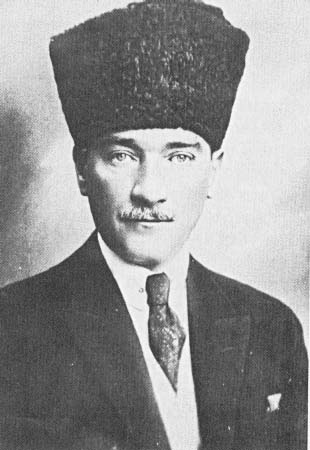
"There are two Mustafa Kemals. One the flesh-and-blood Mustafa Kemal who nowstands before you and who will pass away. the other is you, all of you here who will go to the far corners of our land to spread the ideals which must be defended with your lives ifnecessary. I stand for the nation's dreams, and my life's work is to make them come true." Atatürk stands as one of the world's few historic figures who dedicated their livestotally to their nations. He was born in 1881 (probably in the spring) in Salonica, then an Ottoman city, now inGreece. His father Ali Riza, a customs official turned lumber merchant, died when Mustafawas still a boy. His mother Zubeyde, adevout and strong-willed woman, raised him and his sister. First enrolled in a traditionalreligious school, he soon switched to a modern school. In 1893, he entered a military highschool where his mathematics teacher gave him the second name Kemal (meaning perfection)in recognition of young Mustafa's superior achievement. He was thereafter known as MustafaKemal. In 1905, Mustafa Kemal graduated from the War Academy in Istanbul with the rank ofStaff Captain. Posted in Damascus, he started with several colleagues, a clandestinesociety called "Homeland and Freedom" to fight against the Sultan'sdespotism. In 1908 he helped the group of officers who toppled the Sultan. Mustafa Kemal'scareer flourished as he won his heroism in the far corners of the Ottoman Empire,including Albania and Tripoli. He also briefly served as a staff officer in Salonica andIstanbul and as a military attache in Sofia. In 1915, when Dardanelles campaign was launched, Colonel Mustafa Kemal became anational hero by winning successive victories and finally repelling the invaders. Promotedto general in 1916, at age 35, he liberated two major provinces in eastern Turkey thatyear. In the next two years, he served as commander of several Ottoman armies inPalestine, Aleppo, and elsewhere, achieving another major victory by stopping the enemyadvance at Aleppo.
On May 19, 1919, Mustafa Kemal Pasha landed in the Black Sea port of Samsun to startthe War of Independence. In defiance of the Sultan's government, he rallied a liberationarmy in Anatolia and convened the Congress of Erzurum and Sivas which established thebasis for the new national effort under his leadership. On April 23, 1920, the GrandNational Assembly was inaugurated. Mustafa Kemal Pasha was elected to its Presidency. Fighting on many fronts, he led his forces to victory against rebels and invadingarmies. Following the Turkish triumph at the two major battles at Inonu in Western Turkey,the Grand National Assembly conferred on Mustafa Kemal Pasha the title ofCommander-in-Chief with the rank of Marshal. At the end of August 1922, the Turkish armieswon their ultimate victory. Within a few weeks, the Turkish mainland was completelyliberated, the armistice signed, and the rule of the Ottoman dynasty abolished. In July 1923, the national government signed the Lausanne Treaty with Great Britain,France, Greece, Italy, and others. In mid-October, Ankara became the capital of the newTurkish State. On October 29, the Republic was proclaimed and Mustafa Kemal Pasha wasunanimously elected President of the Republic. Atatürk married Latife Usakligil in early 1923. The marriage ended in divorce in 1925. The account of Atatürk's fifteen year Presidency is a saga of dramatic modernization.With indefatigable determination, he created a new political and legal system, abolishedthe Caliphate and made both government and education secular, gave equal rights to women,changed the alphabet and the attire, and advanced the arts and the sciences, agricultureand industry. In 1934, when the surname law was adopted, the national parliament gave him the name"Atatürk" (Father of the Turks). On November 10, 1938, following an illness of a few months, the national liberator andthe Father of modern Turkey died. But his legacy to his people and to the world endures. |