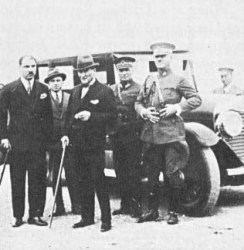
| "The major challenge facing us is to elevate our national life to the highest level of civilization and prosperity."
Atatürk's aim was to modernize Turkish life in order to give his nation a new sense of dignity, equality, and happiness. After more than three centuries of high achievement, the Ottoman Empire had declined from the 17th to the early 20th Century: With Sultans presiding over a social and economic system mired in backwardness, the Ottoman state had become hopelessly outmoded for the modern times. Atatürk resolved to lead his country out of the crumbling past into a brave new future. In his program of modernization, secular government and education played a major role. Making religious faith a matter of individual conscience, he created a truly secular system in Turkey, where the vast Moslem majority and the small Christian and Jewish minorities are free to practice their faith. As a result of Atatürk's reforms, Turkey -unlike scores of other countries- has fully secular institutions. The leader of modern Turkey aspired to freedom and equality for all. When he proclaimed the Republic, he announced that " the new Turkish State is a state of the people and a state by the people." Having established a populist and egalitarian system, he later observed: "We are a nation without classes or special privileges." He also stressed the paramount importance of the peasants, who had long been neglected in the Ottoman times: " The true owner and master of Turkey is the peasant who is the real producer."
To give his nation a modern outlook, Atatürk introduced many reforms: European hats replaced the fez; women stopped wearing the veil; all citizens took surnames; and the Islamic calendar gave way to the Western calendar. A vast transformation took place in the urban and rural life. It can be said that few nations have ever experienced anything comparable to the social change in Atatürk's Turkey.
|